Tuesday, February 25, 2014

Author Interview: Bonny Becker

by Cordelia Jensen

Hi Bonny! 

Thanks so much for joining us on the Big Blue Marble Bookstore blog. I have been a huge fan of the Bear picture books since my own (now 8-year-old) twins were small. I love the dynamic between Bear and Mouse. For some reason, reading the books out loud I always read Mouse in a British accent! 

Did Bear or Mouse come to you first? Or their relationship?

Mouse came first. He popped into my head one day full grown as a pesky mouse who just couldn’t be gotten rid of! Then I had the delightful task of figuring out who my mouse would bug. I went through several animals in my head before I hit upon a bear and that seemed perfect.

Are there any more Bear and Mouse books coming soon? Have you ever thought about writing a book from Mouse’s perspective? 

Yes, there are two more Mouse and Bear books in the works. A Library Book for Bear comes out this September. And next year or perhaps the year after that will be A Halloween for Bear. I never thought about doing a book from Mouse’s perspective. I wonder who cheers him up?

Good question! Maybe another tiny animal . . . While having been familiar with the Bear and Mouse picture books for a long time, I just finished reading The Magical Ms. Plum. What a funny book! The kids and I were laughing and laughing. When the first tiny horse came out of the closet I was really surprised. The book has this surreal quality to it. Where did the idea for those books come from?

This book is a lot harder for me to track in terms of how the idea came together. I know I was working on a story about a boy who finds a tiny t-rex. One small enough to fit into his backpack. I just couldn’t seem to make it work! I think that got me thinking about other tiny animals and one thing led to another. I do remember the various elements—at school, a magical school teacher, different kids, different animals, a lesson learned—kind of assembled themselves one by one in my mind.

My kids were wondering what would happen to Lucy if she went into the closet . . . they would like a sequel so they can find out! If you had been in Ms. Plum’s classroom as a child, what animal do you imagine would have come out for you?

That’s a good question and a hard one for me! There are animals I would want to come out like a jaguar or a unicorn. Then there’s the animal that probably would have come out given my personality. I was a huge reader and a thinker and a little odd. I’m thinking maybe an owl? But then again maybe I needed a wild, funny monkey! I am working on a sequel, but it will be a new class not Lucy’s class. I like to think, though, that every kid in Ms. Plum’s class did get a chance to go into the closet. Lucy is such a good sport, I think I’d give her a unicorn.

It is interesting that in both the Magical Ms. Plum book and the Bear and Mouse books, there are small animals in unexpected places. (The Mouse in the cake maybe being my favorite.) What is your own relationship to animals? Do you have many pets?

I have animals in almost all my 12 books! And it’s not something I realized until I’d written about five or six books. My books include The Christmas Crocodile, the story of crocodile who gets delivered to the wrong address at Christmas, An Ant’s Day Off about the first ant in history to take a day off and, of course, the Mouse and Bear books. I’ve written about a lizard who wants to be an artist and one about the way various animals feel to the touch—like the wooly curls of a sheep or the slippery scales of a fish. Animals show up a lot in my work.

I had four sisters and a brother, so I grew up with a lot of siblings and a lot of pets. But I’m not sure if that’s the reason animals show up so much. They are good substitutes for people. They can be such distinct characters. You can have a lot of fun with them without making fun of people themselves

And now, our three for three book-related questions:

1. What were three of your favorite books as a child and/or teen?

All the Oz books, Mary Poppins, and the Narnia books. Anything with magic in
it!

2. What are three books you’ve read recently that surprised you?

Eleanor and Park by Rainbow Rowell, The Fault in Our Stars by John Green both surprised me by how caught up in the story I got. I don’t read much YA, but I was impressed! And The Female Brain by Louann Brizendine. I’m just starting it, but it’s full of fascinating facts about brain development and gender differences.

3. What are three books that influence/d your writing?

Charlotte’s Web, The Wizard of Earthsea, The Lion, the Witch and the Wardrobe

Thanks so much for joining us, Bonny!

Bonny Becker is author of the best-selling Mouse and Bear books, including A Visitor for Bear, New York Times bestseller, winner of the E.B. White Read Aloud Award and Amazon’s Picture Book of the Year. Her latest book is A Birthday for Bear. Poor Bear is even grumpy about birthdays! Her middle-grade novel, The Magical Ms. Plum, won the 2010 Washington State Children’s Book Award. In all, she’s published 12 books for children. She is also an instructor for the Northwest Institute of Literary Arts, an accredited program for a Masters of Fine Arts in Writing. Visit her at bonnybecker.com.

Thanks for reading!!! If you're local to the area, please let the bookstore know if you would like a copy of A Visitor for Bear, or any of Bonny's other books. You can email orders to orders [at] bigbluemarblebooks [dot] com, call us at (215) 844-1870, or come see us at 551 Carpenter Lane, in the Mt. Airy neighborhood of Philadelphia.
Next up: In mid-March, come check out Jen's interview with Elisa Ludwig, author of Pretty Crooked and the upcoming Pretty Sly.

Tuesday, February 18, 2014

Author Interview: Judy Schachner

by Jennifer Sheffield

Hi, Judy! We're looking forward to seeing you at our Kids' Literary Festival in May. Congratulations on the release of Bits & Pieces this past fall! Here’s a bit of synopsis from the book jacket:

“Tink has everything he ever wanted: delicious treats, hugs and kisses, and even a kitten to raise. The only thing missing is wild outdoor adventure. So when the opportunity arises, Tink sneaks away -- and becomes an outdoor cat for one unforgettable night...”

I was sorry to hear the news of the recent death of Tink, your model for the protagonist in Bits & Pieces, and I’m curious to know what he was like. Was he truly as spacey as his portrayal in the book? As adventurous? And did he indeed acquire a kitten of his own to raise?

Tink was hilarious! I say was, because he passed away only just recently at the age of 21. He had a long and wonderful life eating inappropriate things like pool noodles, packing peanuts and a flip-flop. Tink was generous with his licks - He licked everything and everyone in sight and he was SO nurturing to the kittens that came to live with us, especially one kitten named Skippyjon Jones. My old cat Simon had earned the name of "The Grannyman" because he was just like a kindly old Granny to Tink when he was tiny. In turn, Tink earned the name of “The Mother-Brother" when Skippy came along because he was both like a mother and a brother to his new kitten. Was he spacey? Most definitely! I seriously think that he had a brain the size of a frozen pea…a dried up frozen pea, which rolled out of his ear one night at dinner. I know this to be true because I found it on my kitchen floor when i was cleaning up after we had finished our meal…what else could it have been? We had eaten creamed corn that night.

I have developed the strong impression (please correct me if I’m wrong...) that in the Grannyman/B&P series, the plot and characters are drawn fairly true to life, whereas the Skippyjon Jones books...tend toward the fanciful. (Though I do see a Siamese called Skippy on your Grannyman dedication page.) How does the writing experience feel different for the two series?

Yes, Jen, both The Grannyman and Bits & Pieces are drawn upon my life with our cats, but to some extent so are the Skippy Tales. Skippy was a very funny Siamese with an adorable personality. One day he was stung on his noggin by a large bee in our basement and that was when he began to speak with a Spanish accent…no one else ever heard him, but I can assure you that it was all true. I love writing the SJJ books because that is when I am most in touch with my six-year-old self…I can really let the cat out of the bag so to speak and I do.

The dedication page for The Grannyman has a beautiful display of cats, some grouped together and some by themselves, who I presume are your feline companions (up through 1999). How many of your cats have you drawn and written about? Do you specifically favor the depiction of Siamese cats, or is that just the way things turned out?

The title page in The Grannyman is one of my favorites because they are indeed the portraits of all my fur children dating back to the 1950’s. Our tabby, Mr. Mickey, made an appearance in my first book Willy and May (still in print) along with my very first Siamese named Frankie. Our dogs have been in my books as well. Buster, our adopted pit bull, is in Skippyjon Jones Class Action, though he made his first real appearance in Yo Vikings (my most favorite book) along with another one of our adopted pooches named Mugsy (talk about a crazy dog!). I do have a special relationship with the Siamese model of feline fuzziness though. They are so very different from other cats. Male Siamese are known to be the most nurturing of all the cat breeds and I have found that to be true. I lost my mother when I was quite young and my oldest brother, knowing that I was having a tough time, brought home a Siamese kitten just for me. I have been smitten ever since.

How do you feel your drawing style has changed over time?

Well…I don’t know quite how to answer that one. The Skippy books are very colorful and boisterous and labor-intensive while books like Bits & Pieces and The Grannyman are quieter in both color and line. I think I prefer the quieter ones and will be doing more of them in between the Skippy books. I just hope to keep improving - I have ever so much to learn (she said in her very best British accent). I am a very harsh critic of my own work - I tend to see only the mistakes. Plus I am a luddite; I have NO computer skills - none. Having said that I must confess to a preference for artwork done by the human hand. I love the imperfections and the warmth of real live art.

Among my favorite scenes in the book are the pages outlining Tink’s intoxicating stroll in the daylight and moonlight. Do you share Tink’s fascination with the outdoors? Do you do any of your drawings “on location,” or do you create the outside world from an inside space?

For an indoor cat, Tink certainly did have a fascination for the outdoor life; in his later years it became an obsession - trying to escape every time he heard a door open. I’m more of an indoor girl - though I think I have an obsession with weather. I love storms, especially snow storms. I love being in my studio working on my books when it snows - I can think of nothing better. Most everything I draw or paint is pulled out of my head…my imagination.

I'm glad to hear you like the snow, considering the winter we've been having!

I’m a cat person myself, and I recently included Bits & Pieces in a “staff pick” list of books with cats in them. What are some picture books featuring cats that you particularly like?


It’s not really a cat book but I love Sam, Bangs and Moonshine by Eveline Ness. I identify with the little girl who has just lost her mother. Sam has a cat that follows her everywhere. She talks to him and she says that Bangs could talk if he wanted to. I think it’s a near perfect little book which deals beautifully with the subject of death. Other favorites of mine are Mrs. Lovewright and Purrless Her Cat by Lore Segal, love the orange tabby in the Church Mice books by Graham Oakley and it goes without saying, anything by Clare Turlay Newberry.

Do you have current or upcoming projects you’d like to tell us about?

I am finishing up the newest Skippy adventure, titled Snow What. It involves tights, sausages, and kissing. It will be on your doorstep this fall - that is, if I ever do finish!

And now for our "3 for 3" book questions:

1. What were 3 of your favorite books from childhood/teen years?

I adored Little Black Sambo - The idea of tigers turning into butter positively floored me. I can even remember drawing that image in my first grade classroom - only, I think I drew the tigers melting by the stove in our kitchen. I don’t remember having many books as a kid and anyway the thing I was most interested in was drawing. When I was a bit older, I do remember just loving the book Rascal by Sterling North. I didn’t have glasses and I needed them, so reading was difficult.

2. What are 3 books that you've read recently that surprised you?

I was never a big fan of Eat, Pray, Love by Elizabeth Gilbert, so I was pleasantly surprised by how much I enjoyed The Signature Of All Things. Loved it! And who knew how interesting it would be to spend time inside the mind of Thomas Cromwell? Wolf Hall and Bring Up The Bodies, both by Hilary Mantel, blew me away - could not put them down. Finally, The Sense Of An Ending by Julian Barnes was, in my opinion, bloody brilliant!

3. What are 3 books that influence/d your work?

A Visit To William Blake's Inn, by Nancy Willard, illustrated by Alice and Martin Provensen, A Girl Named Zippy, by Haven Kimmel, and, last but not least, all works by Arthur Rackham.

Thank you so much for joining us!

Judy Schachner was born into an Irish Catholic working class family from New England. Money was as tight as their apartment was tiny and though she may not have had the easiest of childhoods, she credits her imagination with helping her survive it.

She can't ever remember a time when she was not drawing and like most budding artists she doodled on everything, including her father's bald head. She drew herself into stories where she was the smartest in her class and into a family where mothers lived to a ripe old age. In many ways, Judy feels that her own life has resembled the fairy tales she loved reading as a child, complete with a happy ending. And the best part of this author/illustrator's story? She married a prince of a guy and they had two beautiful daughters and just like the mothers in her earliest tales, she plans on living to a ripe old age.

Described by the New York Times as “…something like the James Joyce for the elementary school set…,” Judy Schachner is the #1 NY Times Best Selling Author/Illustrator of over 23 books for children including Bits & Pieces, the Skippyjon Jones series, Yo Vikings, The Grannyman, and Willy and May. She has won many awards including the first E. B. White Read Aloud Award.

Thanks for reading!!! If you're local to the area, please let the bookstore know if you would like a copy of Bits & Pieces, or any of Judy's other books. You can email orders to orders [at] bigbluemarblebooks [dot] com, call (215) 844-1870, or come see us at 551 Carpenter Lane, in the Mt. Airy neighborhood of Philadelphia.

Also, come check out our annual Kids' Literary Festival this May, where Judy will be among our lovely literary guests.
Next up: On February 25th, come check out Cordelia's interview with Bonny Becker, author of the Bear series and the Ms. Plum books.

Sunday, February 16, 2014

Grace's Five Books Mentioned in Cheryl Strayed's Wild

To celebrate Wild's place as #1 bestseller at this store in 2013, I've decided to make a list of some of the great books Cheryl Strayed mentions in her memoir. On her hike from the Mojave Desert all the way to Washington State, Strayed collects books to read in her tent, and against her spiritual judgment, she burns each one after finishing it to reduce the weight of her hiking pack. (Don't try this at home!)

As I Lay Dying by William Faulkner (Vintage Books, $14.00)

The Dream of a Common Language by Adrienne Rich (W W Norton, $14.95)

Lolita by Vladimir Nabokov (Vintage Books, $15.95)

The Complete Stories by Flannery O'Connor (Farrar Straus & Giroux, $18.00)

The Ten Thousand Things by Maria Dermout (New York Review of Books, $14.95)

Grace Gordon, February 2014

Wednesday, January 29, 2014

Mariga's Hardback/Paperback Combo Mix

Editor's note: with apologies to Mariga, I neglected to post this at the end of December...

Hyperbole and a Half: Unfortunate Situations, Flawed Coping Mechanisms, Mayhem, and Other Things That Happened by Allie Brosh (Touchstone Books, $17.99)

Diary of a Wimpy Kid: Hard Luck by Jeff Kinney (Amulet Books, $13.95)

The Christmas Gift by Lori Evert (Random House Children's Books, $20.99)

How it All Began by Penelope Lively (Penguin, $16.00)

The House of Silk by Anthony Horowitz (Mulholland Books, $14.99)

Mariga Temple-West, December 2013

Monday, January 27, 2014

Bookstore Bestsellers, 2013

Happy New Year! I'd like to present the annual list of Big Blue Marble bestsellers -- the top 20 books sold in 2013, and top 25 overall.

What books have you read and loved over the past year?

Top 20 Bestsellers at Big Blue Marble in 2013:

1) Wild by Cheryl Strayed
2) Good Morning, Beautiful Business: The Unexpected Journey of an Activist Entrepreneur and Local Economy Pioneer by Judy Wicks (local author)
3) The Buddha in the Attic by Julie Otsuka (2013 selection for the One Book, One Philadelphia program)
4) Keeper by Kasey Jueds (local author)
5) Wonder by R.J. Palacio
6) Dear Life: Stories by Alice Munro
7) Drift by Jon McGoran (local author)
8) Quiet: The Power of Introverts in a World That Can't Stop Talking by Susan Cain
9) The Snowy Day by Ezra Jack Keats
10) Diary of a Wimpy Kid: Hard Luck by Jeff Kinney
11) Hyperbole and a Half : Unfortunate Situations, Flawed Coping Mechanisms, Mayhem, and Other Things That Happened by Allie Brosh
12) House of Hades by Rick Riordan
13) The Fault in Our Stars by John Green
14) Dog Songs by Mary Oliver
15) Flight Behavior by Barbara Kingsolver (locavore)
16) Signature of All Things by Elizabeth Gilbert (local author)
17) The Book Thief by Markus Zusak
18) Goldfinch by Donna Tartt
19) Round House by Louise Erdrich
20) Beautiful Ruins by Jess Walter

Top 25 Bestsellers at Big Blue Marble to Date:

1) Harry Potter and the Deathly Hallows by J.K. Rowling
2) Body Trace by D.H. Dublin (local author)
3) Philadelphia Chickens by Sandra Boynton (onetime local author)
4) The Hunger Games by Suzanne Collins
5) Good Night Philadelphia by Adam Gamble and Cooper Kelly (local setting)
6) Good Night, Gorilla by Peggy Rathman
7) Eat, Pray, Love by Elizabeth Gilbert (local author)
8) The Snowy Day by Ezra Jack Keats
9) The First 1000 Days by Nikki McClure
10) The Daring Book for Girls by Miriam Peskowitz (local author) and Andrea Buchanan
11) The Lightning Thief by Rick Riordan
12) Goodnight Moon by Margaret Wise Brown
13) The Buddha in the Attic by Julie Otsuka (2013 selection for the One Book, One Philadelphia program)
14) The Girl with the Dragon Tattoo by Stieg Larsson
15) The Absolutely True Diary of a Part-Time Indian by Sherman Alexie (selected as companion book for the 2011 One Book, One Philadelphia program)
16) Dreams from My Father by Barack Obama
17) The Invention of Hugo Cabret by Brian Selznick
18) Catching Fire by Suzanne Collins
19) The Paper Bag Princess by Robert Munsch
20) Ivy and Bean by Annie Barrows
21) Flotsam by David Wiesner (local author)
22) Blood Poison by D.H. Dublin (local author)
23) Zen Shorts by Jon Muth
24) The Book Thief by Markus Zusak
25) Three Cups of Tea by Greg Mortenson
Bonus: Tied for spot 26:
a) Ella Elephant Scats Like That by Andy Blackman Hurwitz (local author)
b) The Mysterious Benedict Society by Trenton Lee Stewart

Happy reading for 2014!

Tuesday, January 14, 2014

Author Interview: Miriam Glassman

by Cordelia Jensen

Hi Miriam!

Your book Call Me Oklahoma! was my daughter’s favorite book of the summer. Here's a brief synopsis:

"From now on, call me Oklahoma!" nine-year-old Paige Turner announces on the first day of fourth grade. She is determined that this year she will be different: someone gutsy—brave enough to stand up to her tormentor, class bully Viveca Frye. It takes a lot of work for Paige to bring out her inner Oklahoma, but she's helped along the way by her best friend, her sympathetic teacher, her bratty cousin, and some hilarious but inspiring events at home and at school.
Paige does manage to overcome most of her fears, and in the process she learns that a true friend offers all the courage she needs.

First, let’s talk names. My daughter’s name Lily is in this book. And my name, Cordelia, is also in this book. And Paige’s whole idea is that she will be a braver person if she has a name like Oklahoma as opposed to Paige. Is this concept what first brought on the idea for the story? Was she ever going to be named a different state besides Oklahoma or was it always Oklahoma? Did you ever wish you could change your name when you were a kid? 

Hi Cordelia!

I’m so delighted that your daughter enjoyed Call Me Oklahoma! And how great to meet an actual Cordelia! As you know, it’s Cordelia who inspires Paige to reinvent herself. I love the name, and it seemed fitting for the bouncy, dynamic cousin in my book.

But why Oklahoma? Well, the seed of the story came from my younger daughter who came home from camp one day and mentioned a girl named, Oklahoma. I said, “Wait a minute. You have a friend named, Oklahoma?” And my daughter said, “Well, that’s not her real name. It’s just what she asked people to call her.” That got me thinking: Why would a person ever choose the name, Oklahoma? And would having a feisty name like that change one’s self-perception? That’s when Paige Turner stepped into my life. I wanted to write about a kid who feels the power of names, and who tries to embody the spirit of her new name and become more courageous. I never thought about Paige taking on any other name. Oklahoma is not only fun to say, but in this book, also has associations with the musical, which is about the Oklahoma territory becoming a state--another story of change and promise. It seemed logical to me that Paige would be moved by the optimism of the title song and the spirited characters. And in her choice of such a unique name, she signals that she’s already begun connecting with her inner Oklahoma.

As for my own name, yes, absolutely, I wanted to change it. Growing up in the 60’s and 70’s, my friends all had fun, high-energy names: Amy! Debbie! Lisa! Donna! Karen! Vicki! And then there was...Miriam. It felt like a heavy, wool coat I had to wear all year round, and I dearly wished my name was Julie. Incidentally, the editor on this book is named, Julie. I’d also like to add that I’ve since made peace with my name.

Your illustrations are terrific. Did you submit the story with them or add them 
later? How does your writing process compare to your drawing process? Is one more energizing than the other? More frustrating? 

I had a lot of trepidation about sending illustrations with the story. Although my agent wanted to include my sketches with the manuscript, I made her promise she wouldn’t unless the story was accepted. I hadn’t illustrated professionally for years, and had galloping insecurities about my drawings. I got a little zing of courage, however, when the story was accepted; so the sketches were sent to Holiday House. I figured by then, it couldn’t hurt. Turned out, the editor felt the spot illustrations made the piece stronger. That really surprised me and the lesson I took away from that experience is, don’t hold back anything that enriches or energizes a piece for you.

I enjoy both writing and illustrating, but writing is often more frustrating. It’s much
harder for me to get narrative and characters down on paper than it is to realize my ideas for drawings. That said, I went through pads of tracing paper till I was happy with the way the characters looked. I’m sure that was partly due to being so out of practice. Also, because I draw in a cartoon style, each line has to feel just right to me. The size of a dot for an eye or the slant in the line of a mouth radically affects the look and feel of a character.

I love the final paragraph of the book. And the idea that we all have so many 
possibilities inside of us and we don’t just have to be this one way or one thing. I like how you encourage self-exploration in the book and I am glad that Paige’s parents do too. Is this something that grew out of your own experience as a parent? As a kid? Or was it just the logical way to take Paige’s story?

The idea of reinventing oneself and the struggle to be one’s true self has long been a theme I’ve been interested in, both as an individual and as a parent. I’m fascinated by how we define ourselves, and the courage it takes to redefine ourselves as we grow and change.

Viveca Frye is a strong antagonist and a multi-dimensional one. Did you do any free writing from her perspective? 

I didn’t do any free-writing for Viveca, but she emerged more fully in revision. I wanted her to be more of a power player than textbook bully. We’ve all known kids who are both admired and feared and who lean into their insecurities rather than their strengths. Towards the end of the story, however, Paige encourages Viveca to nurture one of strengths, which is her artistic talent. And in embracing it rather than dismissing it, there’s a suggestion that Viveca is on her way to discovering one her many possible selves.

Is there anything else you would like readers to know about this book? 

This was my kitchen sink book in the sense that a lot of the material came from scraps of my life, both past and present: my daughter’s old clogs, the “magic” rubber light bulb, her familiarity with personal jinxes, the cottage cheese monster game I played with my brother, and the pets in the talent show. It was like cleaning out a closet and discovering all this good stuff I could use to build Paige’s world.

What are you working on now? Any chance of a sequel for Paige? 

I am currently working on a middle-grade novel about kids at an overnight camp. And yes, I’d like to follow Paige through fourth grade, maybe focus on the run-up to the winter holidays. So, chances are the title won’t be, Call Me Cincinnati!

And now for our “3 for 3” book-related questions:

What were 3 of your favorite books as a child/teen? 

1. The Lonely Doll by Dare Wright. I truly felt pulled inside this story, and think it
was my first experience of a book as another world I could inhabit just by turning
the pages.

2. Harriet the Spy by Louise Fitzhugh. This book totally spoke to me. I admired and greatly envied Harriet’s brash honesty.

3. Agatha Christie mysteries. These books did a spectacular job of blocking out a lot of middle school for me!

What 3 books have you read recently that surprised you? 

Hard to think of a book that surprised me, but recent books that have stayed with me include: Life After Life by Kate Atkinson, P.S. Be Eleven, by Rita Williams-Garcia, and A Constellation of Vital Phenomena by Anthony Marra.

What 3 books influence/d your writing? 

1. A Girl Called Al by Constance C. Greene. The economy of dialogue and sharp observations taught me a lot about writing humor. 

2. Jennifer, Hecate, Macbeth, William McKinley, and Me, Elizabeth, by E.L.
Konigsburg. The voice and characters in this book have stayed with me since
I first read it in fifth grade, and Konigsburg’s intelligent, funny stories remain
models I turn to.

3. Birds of America by Lorrie Moore. I love these exquisite short stories, especially for their invigorating blend of anguish and humor.

Thanks so much! 

Thank you, Cordelia!

Miriam Glassman is the author/illustrator of CALL ME OKLAHOMA! (Holiday House, 2013), recently selected as one of the New York Public Library’s list of top children’s books for 2013. She is also the author of BOX TOP DREAMS (Delacorte), and a picture book, HALLOWEENA (Atheneum), illustrated by Victoria Roberts. 

Miriam has a master’s degree in teaching from Simmons College, and an MFA in Writing for Children and Young Adults from Vermont College of Fine Arts. She has worked in children’s book publishing, as a library assistant, a children’s book reviewer for Publisher’s Weekly and as an illustrator for the educational market. Miriam has two grown daughters and lives with her husband in Massachusetts.

Thanks for reading!!! If you're local to the area, please let the bookstore know if you would like to place a special order for Call Me Oklahoma!  You can email orders to orders [at] bigbluemarblebooks [dot] com, call (215) 844-1870, or come see us at 551 Carpenter Lane, in the Mt. Airy neighborhood of Philadelphia.

Upcoming interviews: In the middle of February, look for Jen's interview with Judy Schachner, author/illustrator of Bits & Pieces and the Skippyjon Jones series.  At the end of the month, check back for Cordelia's interview with the talented Bonny Becker, author of the Bear series and the Ms. Plum books!

Thursday, December 26, 2013

Beyond Nancy Drew and Encyclopedia Brown: Sheila’s Five Mystery Series for Kids

Nate the Great by Marjorie Weinman Sharmat (Random House, $4.99 each)

Nancy Clancy, Super Sleuth by Jane O'Connor (HarperCollins, $9.99 each)

Enola Holmes by Nancy Springer (Penguin, $6.99 each)

The Sisters Grimm by Michael Buckley (Harry Abrams, $7.95 each)

The Clubhouse Mysteries by Sharon Draper (Simon and Schuster, $4.99 each)

Sheila Avelin, December 2013

Monday, December 23, 2013

Jen’s Five Brand New Books of Cats!

Meditating Cat by Jean-Vincent Senac (Little, Brown Books, $10.95)
A coloring book to help clear your mind…

Mr. Wuffles! by David Wiesner (Houghton, $17.99)
The story of a cat with ennui, the aliens who enliven his day, and the help they receive from the locals. See my recent author interview here.
Update, 1/27/14: A Caldecott Honor Book!

Big New Yorker Book of Cats by New Yorker Magazine (Random House, $40.00)
Cartoons! Essays! Poetry! Cartoons! Um, Cartoons!

Bits & Pieces by Judy Schachner
(Penguin, $17.99)

Sequel to her picture book The Grannyman. Look for an author interview on the blog in February!

Unlikely Loves: 43 Heartwarming True Stories from the Animal Kingdom by Jennifer Holland (Workman, $13.95)
Not all cats, but some! I was impressed with the intro essay about what constitutes love in this context.

Jennifer Sheffield, December 2013

Sunday, December 22, 2013

Elliott's Five Poets That Will Make You Gasp for the Beauty of It All

As proof of Alfred Corn's assertion that "poetry has never fully disengaged itself from its associations with shamanism," five contemporary poets who will woo, sway, and shake you.

me and Nina by Monica Hand (Alice James Books, $15.95)

Bewilderment: New Poems and Translations by David Ferry (University of Chicago Press, $18)

Kingdom Animalia by Aracelis Girmay (BOA editions, $16)

Traveling Light: Poems by Linda Pastan (WW Norton, $15.95)

A Child's Christmas in Wales by Dylan Thomas (New Directions, $9.95)

BONUS BOOK!
A Child's Christmas in Wales by Dylan Thomas, illustrated by Chris Raschka (Candlewick, $9.99)

Elliott batTzedek, December 2013

Friday, December 20, 2013

Janet's 5 "Hand-Picks" for December

(Clockwise from top: Janet, bright peacock, white unicorn, extremely winsome harbor seal, three-headed blue dragon, orange octopus.)

Tuesday, December 17, 2013

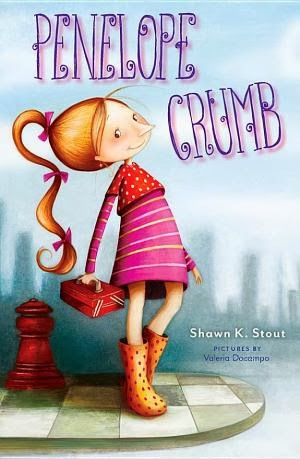
Author Interview: Shawn K. Stout

by Cordelia Jensen

Today's interview features Shawn K. Stout and her spunky character Penelope Crumb. Here's a bit about the Penelope Crumb series, excerpted from Shawn's website:

The first three books in my new middle grade series, Penelope Crumb, Penelope Crumb Never Forgets, and Penelope Crumb Finds Her Luck published by Philomel/Penguin, are in bookstores now! Penelope is a fourth grader with a big nose and an even bigger imagination. She does a lot of sneaking around, fibbing an eensy-weensy bit, and breaking about a gazillion of her mother’s rules. Oh goodness. This Penelope Crumb girl sounds like a handful, doesn’t she?
Penelope Crumb was chosen as a Bankstreet Best Book of 2013!
Penelope has her very own book trailer on YouTube. If you check it out, I will like you a whole big bunch.
The fourth book in the series, Penelope Crumb Is Mad at theMoon, will be released in 2014. 

Now on to the interview . . . 

Hi Shawn! The Penelope Crumb series is just delightful! I loved reading it out loud to my almost 8 year old twins. They both laughed a whole lot. 

I noticed that the Penelope Crumb series focuses quite a bit on Penelope’s relationships with senior citizens. Was this intentional? Are you interested in how kids interact with the elderly?

This fact only occurred to me only after I’d written the third book in the series (so this ought to tell you how alarmingly attuned I am to what I’m writing). Although not intentional, I suppose it’s not surprising. Much of my childhood was spent hanging around with older people. My grandmother lived with us for a time, and when her arthritis got bad enough that she could no longer grip a bowling ball and had to drop out of her bowling league, I took her place. I was 14, and everybody else was pushing 80. I had a headgear, they had hearing aids. There was symmetry.

Yeah, I was That Girl.

Penelope is charming but she certainly has her faults. I was interested in how much I felt connected to her but also pretty sure she was “in the wrong” a fair amount of the time. Was this a hard balance for you to strike as a writer?

I like to think that Penelope makes the wrong decisions for the right reasons. She definitely has a unique view of how the world works, or should work, and I think she recognizes on some level that she’s a little different from other kids her age—and not just because of her big nose or because her father is Graveyard Dead. Although the latter has definitely shaped her experience and worldview. These differences are constantly being revealed to her, and as they become evident, she has to understand and learn how to deal with them. Most of the time, she makes the wrong choices, but isn’t that what being young is about? It was for me, at least.

I wanted Penelope to be different but always likeable, and I think I was aware of crossing that line when writing. Penelope means well, she really and truly does, and as long as I stayed true to her “right reasons” for making such bad choices, I felt readers would (hopefully) still want to root for her. I still root for her.

How did Penelope come to you? Fully constructed? As an image? As a voice?

Nothing ever comes to me fully constructed, sadly. How do you go about getting one of those fully constructed ideas? Someone please tell me immediately.

I had an idea centuries ago for a picture book about a girl with a big nose. I worked on a couple of drafts and then realized 1) I can’t write picture books, and 2) the story could be bigger than I originally conceived. Nearly 30 drafts later, Penelope’s voice is just about the only thing that stuck.

I like how proud Penelope is of her nose. And, in the first book, this pride sort of leads her to her missing grandfather. Such an unusual premise for a book. Is there a part of the book that is sort of a message to kids, to feel okay about the ways they are different? That this difference might even lead to something positive?

I don’t really think about messages in the story while I’m telling it. That is to say, I don’t write with messages in mind. I just try to tell a story and be true to the characters. Penelope is just the sort of character who admires standout features (it’s an artist’s job to notice such things) and happens to be proud of her big nose—for its “standout-ishness” and because it connects her to her dead father and her missing grandfather. Everyone is different, in their own way, after all; it’s just that some differences are on the outside and are more noticeable than others. If readers find a positive message about that from Penelope, something that helps them feel good about themselves, then I’ve got goosebumps.

I like Littie Maple a whole lot. I’m just saying. Any chance she might get her own series?!

Littie Maple should definitely have her own series. I’m in complete agreement with you on that. Let’s start a petition.

Let’s do it!

I read these books out loud to my kids, which made me more aware I think of the repetition in phrases in your characters and the very specific language Penelope uses to see the world (like the way she explains everyone’s expressions). Do you have a favorite catch phrase yourself?

I say “oh crap” a lot. Does that count as a catch phrase? I also say “marvy” every now and then, but only when I’m feeling especially rebellious.

What are you working on now? More Penelope Crumb? Something else?

I recently finished the fourth book in the series, called PENELOPE CRUMB IS MAD AT THE MOON (September 2014/Philomel). Warning: There’s a dreaded square dance involved in this book, and also a mishap at a fire safety assembly. I will say no more…

I’ve also been collaborating with my husband on a top-secret project, and I have a drawer full of manuscripts I need to look at to see if there is any breath in them. If I could find a way to write while I slept, I would be much more productive. Also, if my two-and-a-half year old could type, or spell, that would help me out a lot.

And now for our regular “3 for 3” book-related questions:
1.What were 3 of your favorite books when you were a child or teen?
The Secret Garden by Frances Hodgson Burnett
Ramona the Pest by Beverly Cleary
The Outsiders by S.E. Hinton

2. What are 3 books you’ve read recently that surprised you?
 Dead End in Norvelt by Jack Gantos
Graceling by Kristin Cashore
Piggy Bunny by Rachel Vail

 3. What are 3 books that influence/d your writing?
 The Penderwicks: A Summer Tale of Four Sisters, Two Rabbits, and a Very Interesting Boy by Jeanne Birdsall
Stargirl by Jerry Spinelli
The Evolution of Calpurnia Tate by Jacqueline Kelly

Shawn K. Stout writes books for young people and anyone else who will read them. She is the author of the Not-So-Ordinary Girl series (Aladdin/Simon & Schuster) and the Penelope Crumb series (Philomel/Penguin). She has an MFA in Writing for Children and Young Adults from Vermont College of Fine Arts. She lives with her family, and more dirty dishes than you’d care to count, in Maryland.

Thanks for reading!!! If you're local to the area, please let the bookstore know if you would like to place a special order for any of the Penelope Crumb books.  You can email orders to orders [at] bigbluemarblebooks [dot] com, call (215) 844-1870, or come see us at 551 Carpenter Lane, in the Mt. Airy neighborhood of Philadelphia.

In January, look for Cordelia's interview with Miriam Glassman, author of the chapter book Call Me Oklahoma, and Jen's interview with Judy Schachner, author of the Skippyjon Jones series and the new picture book Bits & Pieces! 

Saturday, November 30, 2013

Jen’s Five Kids’ Books Demonstrating That Vehicles Are Not Just for Boys

One of Micah’s favorite bedtime books has beautiful illustrations, wonderful, flowing text, and five tough trucks getting ready for bed. All of the trucks are male. Switching the pronouns around when we read it is effective but complicated, and I am grateful when we find books that provide some gender diversity without our intervention.

By the way, I would like to emphasize that this list of books is Not Just for Girls. Just as unjust, in my opinion, as raising a girl who thought trucks were only for boys would be raising a boy who would tell her so.

Phoebe and Digger by Tricia Springstubb (Candlewick, $16.99)
Girl with truck (and new sibling).

Maisy Drives the Bus by Lucy Cousins (Candlewick, $3.99)
Female mouse (who is not gender-marked) with bus.

Machines at Work (also Trucks, and Planes) by Byron Barton (HarperFestival, $7.99)
Construction trucks (and other vehicles) with male and female drivers.

The Bus for Us by Suzanne Bloom (Boyds Mills Press, $6.95)
Various vehicles with male and female drivers.

Digger, Dozer, Dumper by Hope Vestergaard (Candlewick, $15.99)
And finally, construction trucks personified, with both male and female (and neutral) pronouns, plus male and female kids/drivers!

Jennifer Sheffield, November 2013

Thursday, November 28, 2013

Five Books That Mariga Loved This Fall

Empty Mansions by Bill Dedman and Paul Clark Newell (Ballantine Books, $28.00)

Inside Outside by Lizi Boyd (Chronicle Books, $15.99)

Bellman & Black by Diane Setterfield (Emily Bestler Books, $26.99)

Mr. Wuffles! by David Wiesner (Clarion Books, $17.99)
[Check out the recent interview with David Wiesner elsewhere on our blog!]

Going Clear by Lawrence Wright (Vintage Books, $15.95)

Mariga Temple-West, November 2013

Tuesday, November 26, 2013

Author Interview: Cori McCarthy

by Cordelia Jensen

Hi Cori!

Thanks for being with us here today to talk about your book The Color of Rain.

Something that is hard for me as a writer is putting my characters in danger. Um, this is NOT your problem. You are great at this. Your characters are in terrible, horrible situations all the time! Does this come naturally to you? Do you struggle with this as a writer? Help the rest of us who suffer from character protection disease, with some pointers. ;)

I admit that sometimes my problem is hurting my characters too much! I’m not quite sure where/how I came up with this…I only know that my favorite stories are the ones with the most earned loss. And my favorite characters—like Jane Eyre, Harry Potter, Frodo Baggins—are the ones who are devastated and yet keep going, keep trying to make a difference. I’ve always attached to resilience in stories, and I guess that can only happen if you march your characters up to the edge of a cliff, and then, push them off.

What came to you first when writing this story? Did you know she was always going to be a space prostitute?

Yes. From day one, this story was always about a space prostitute, but I didn’t write this character to be shocking or to bring up the (very real) cultural issue of teen prostitution. This story was always going to be about a girl who believed that she could use her body to get what she wanted…and that she would learn how wrong that assumption was. Though I’ve never (to my knowledge) met a teen prostitute, I knew far too many girls with Rain’s outlook in high school and college. I wrote this book for them.

Has your book been embraced at all by organizations working to fight against the sex slave trade? I know it takes place in a fictional world, but I think it does get at some real world issues.

I have been reached out to by bloggers who also talk about real world issues, i.e. human trafficking. I would love to be helpful, but I fear that the best I can do is hope that this book helps bring real social issues to light.

It also really gets right to the heart of the issues involved in an abusive relationship and you do an amazing job of showing one of the characters as both really horrible and, at times, attractive—or, at least, we can understand why he might be attractive. Was this hard to pull off or not so much?

The abusive relationship was an area where my amazing editor, Lisa Cheng, really engaged and helped me flesh out the nuances. I had to get to a place where I understood Johnny’s motivation. I had to let Rain understand him as well, which was a challenge. Ultimately, Johnny does whatever he can to get what he wants. And so does Rain. With that core in common, Johnny’s falls for Rain, and Rain, well, she begins to believe that she doesn’t deserve anyone better than Johnny. It’s not the recipe for a typical romance, but then, it is something that happens in the real world.

What was the hardest part about writing this book? What are you most proud of?

This whole book was hard. Writing it was like having heartburn for a solid year. I think, in the end, I’m most proud of Rain. She’s so strong, and yet she’s almost destroyed by her choices. Almost.

I noticed your recent book sale is not science fiction but, rather, dystopian. Correct? Did the process of world building in the two books feel similar? What can you tell us about your new book?

BREAKING SKY, my new YA, is not really dystopian, although it might get lumped in that category out of convenience. It’s near-futuristic, around 2049, and is an extension of current political tensions—a miserable future wherein America is locked in cold war with Asia. In that way, the world building wasn’t terribly difficult as I imagined things getting worse and worse from how they are right now.

I like to refer to BREAKING SKY as “Top Gun for teen girls,” although it’s different than the old cult classic. The main character, Chase Harcourt, call sign “Nyx,” is a fighter pilot at the junior Air Force academy tasked with flying a new kind of jet that could make an important difference to the world climate. That all sounds pretty serious, but unlike RAIN, this book has some playful fun in it. Promise.

And now for our regular “3 for 3” book-related questions:

1.     What were your 3 favorite books from childhood/teen years?
The Catcher in the Rye, The Lord of the Rings, and Leaves of Grass. I kept the last title in my leather bible case and snuck it in to church every Sunday.
2.     What are 3 books that you have read recently that surprised you?
Blaze by Laura Boyle Crompton, Ask the Passengers by A.S. King, and Fangirl by Rainbow Rowell
3.     What are 3 books influence/d your writing?
Jane Eyre, The Catcher in the Rye, Jellicoe Road


Cori McCarthy studied poetry and screenwriting before falling in love with writing for children at Vermont College of Fine Arts. Her debut novel, The Color of Rain, is a space thriller out now from Running Press Teens. Her second novel, Breaking Sky, will be out at the end of 2014 from Sourcebooks Fire. Cori is a cohost on the YA vlog discussion series, The NerdBait Guide. Follow her adventures @CoriMcCarthy or @NerdBaitGuide, or check out her website www.CoriMcCarthy.com.
Cori lives in Michigan with her family and beloved jade trees.

Thanks for reading!!! If you're local to the area, please let the bookstore know if you would like to place a special order for The Color of Rain.  You can email orders to orders [at] bigbluemarblebooks [dot] com, call (215) 844-1870, or come see us at 551 Carpenter Lane, in the Mt. Airy neighborhood of Philadelphia.

Look for Cordelia's upcoming December interview with Shawn K. Stout, author of the Penelope Crumb series! 

Sunday, November 24, 2013

Cordelia's Five Books That Feature Creative Talent as a Major Theme

Fangirl by Rainbow Rowell (St. Martin's Griffin, $18.99)

The Interestings by Meg Wolitzer (Penguin, $27.95)

The Lucy Variations by Sara Zarr (Little Brown, $18)

Under the Mesquite by Guadalupe Garcia McCall (Lee & Low, $17.95)

Exposed by Kimberly Marcus (Ember, $8.99)


Cordelia Jensen, November 2013

Friday, November 22, 2013

Jen’s Six Books with Unexpected Doctor Who References

Doctor Who (in the US, in the '80s) used to be a kind of cult thing. If I introduced someone to the show and they loved it, or if someone I met was (amazingly) already a fan, it was like welcoming people into a little club. Few, weird, fascinating Whovians. And now here we are, with the show’s 50th anniversary coming up tomorrow(!), and lo, the club has grown and changed. I suddenly find that lots of my friends are Doctor Who fans – some, oddly, always have been. References are everywhere. And look: modern-day authors are Mentioning It in Books!

Luka and the Fire of Life by Salman Rushdie (Random House, $15.00)

Beauty Queens by Libba Bray (Scholastic, $9.99)

How to Save a Life by Sara Zarr (Usborne, $8.99)

Weird Things Customers Say in Bookstores by Jen Campbell
(Overlook Press, $15.00)

Fantastic Mistakes: Neil Gaiman’s “Make Good Art” Speech
(William Morrow, $12.99)

Queers Dig Time Lords: A Celebration of Doctor Who by the LGBTQ Fans Who Love It, edited by Sigrid Ellis and Michael Demian Thomas
(Mad Norwegian Press, $17.95)

This is not an unexpected reference but an unexpected book. Where did they all come from? And…why didn’t they consult me?

Jennifer Sheffield, November 2013

Wednesday, November 20, 2013

Five Books That Were Even Better Than Elliott Thought They'd Be

Let's Pretend This Never Happened by Jenny Lawson (Penguin, $16.00)

Hereville: How Mirka Got Her Sword by Barry Deutsch (Abrams, $9.95)

Pride and Prejudice and Zombies by Jane Austen and Seth Grahame-Smith (Quirk Press, $12.95)

Collected Poems, 1965-2010 by Lucille Clifton (BOA Editions, $35.00)

What It Is by Lynda Barry (Drawn & Quarterly, $24.95)

Elliott batTzedek, November 2013

Tuesday, November 12, 2013

Author Interview: David Wiesner

by Jennifer Sheffield

Welcome to three-time Caldecott winner and local author David Wiesner, who joins us to talk about his newest book, Mr. Wuffles!


“I’ve been calling it a nearly wordless picture book that’s full of dialogue that nobody can read.” - Dinah Stevenson, Clarion Books

This is a story of a cat with ennui, the aliens who enliven his day, and the help they receive from the locals.


Hi, David! I have to start by saying that Mr. Wuffles! is a fabulous book. How did you come up with the idea?

Mr. Wuffles! was a long time coming together. It began with a cover I did for Cricket magazine in 1993. On the front was an image of a flying saucer that had landed in the desert. The crew has emerged and is posing for a picture. When you opened the back to see the full image, it is revealed that they have in fact landed in a sandbox and are tiny.

In 2001 I began to try and turn this idea into a book. The opening was visually terrific. We follow the ship as it lands and the visitors begin to explore. Fingertips then enter one frame to set up the turn of the page that reveals the true nature of the situation.

The trouble was, I couldn’t come up with anything else that good for the rest of the story. I tried on and off for several years, but it never gelled.

One thing that did come out of these attempts was the idea that each species would speak in a different language. This was a very appealing visual concept.

And then one day as I was drawing random things in my sketchbook, a solution appeared. I drew a flying saucer –a common occurrence – but this time I covered the ship with little pointy things. I really liked the texture of it. And I thought, “You know, my cat would love to scratch its neck on this. What a cool cat toy.”

And there was my story. I immediately saw a funny and antagonistic relationship between the cat and the little aliens. The story just flowed out.

Does your cat Cricket, as the model for Mr. Wuffles, also disdain store-bought cat toys? If so, what alternate toy did you find that was engaging enough to produce such a brilliant series of play poses?

Cricket’s indifference to store bought toys led me to the storyline. Getting a cat to pose is an impossible task. So, I wasn’t hopeful about her being cooperative.

I had a very small video camera that I put on the bottom of pole so that I could film her down at floor level, since that is where the action takes place. To my surprise, she was very playful. A piece of string was enough to get her rolling around.

As it turned out, she was hyperthyroid, so her metabolism was really revved up! She’s on meds now and back to her old aloof self.

I understand you consulted with a linguist to help derive the aliens’ language. As a linguist myself, I’ve been fascinated with the system of symbols and keep trying to work out what different parts mean. Aside from the group photo, where I’m fairly certain I know exactly what the camera alien is saying and what the response is, I haven’t been able to pull any of the rest of it apart. (Well, except that the square might mean “Ow,” and Δ! is clearly a widely used, strong interjection of some kind.) Do you have a specific translation in mind for each element and utterance, or are they just meant to convey the general sense of what’s going on?

Creating a fully translatable language is a tall order and not something I was aiming for. But, I did want repetition of forms/symbols, which is a significant part of any language. I created a group of about 30 symbols based on geometric forms.

You’re right about the photo scene and the triangle. Also, I figured that the engineer – the one in the green robe (Think Scotty from Star Trek) – would speak a lot of technical jargon. His word balloons have the most symbols. I doubled them up as in fractions. This method of increasing the number of characters was a nice visual solution that I got from Nathan Sanders, a linguist at Swarthmore.

The languages are visual signifiers. While they aren’t literally readable, the gist of their meaning can be inferred from the context of the pictures. Body language, gesture, and facial expressions convey what’s happening. It’s this kind of visual storytelling that picture books excel at.

What was involved in designing the spaceship?

I am a big fan of the classic flying saucer shape. They are clean and simple shapes that look great in flight. Very satisfying to draw. Basically, there are three parts – the top half sphere, the lower half sphere, and the middle circular plane. It’s just a matter of adjusting the top and bottom shapes to create different feels for the ship. I found the texture to be a welcome addition.

My very favorite of your books (now joined by Mr. Wuffles!) has always been June 29, 1999. While they both feature (okay, spoiler for June 29) visits from various aliens, what I love most about both books is the resultant mismatches in scale: ordinary humans and familiar landscapes paired with enormous vegetables in June 29, and here the tiny humanoid aliens paired with pencils and screws and marbles...and, of course, Mr. Wuffles. Is this something you’ve always done? When did you first start juxtaposing people and objects of very different sizes?

Scale change is my favorite visual fantasy. Conceptually it is so simple – make something larger or smaller and its relationship to everything around it changes dramatically. For a human shrunk small, their living room and its furniture become like the Grand Canyon.

As a kid, I fell in love with scale change from watching all the 1950’s Atomically Mutated Giant Bug movies on TV. How can you not love huge ants coming down the street? Just as good were the Atomically Mutated Tiny Person movies - the ultimate example being The Incredible Shrinking Man. It even has a fantastic tiny person vs. cat sequence.

I can tell that landscape and surroundings are very important to your artistry. While clearly you haven’t been hanging around under the radiator, I’m wondering how much time you spend in locales similar to those you create, and how much just happens at the drawing table.

I always want to see what I am drawing. If I can’t find the real thing, I build it.

For example, in June 29, 1999, I had a giant broccoli land in the backyard of my main character. Hard to go out and find that situation. So, I made a group of small houses, fences, and driveways and then put a normal size bunch of broccoli into the scene. Now I could walk around it and view it from all angles, plus above and below, to decide how I wanted to compose the picture.

I’m trying to create a convincing fantasy world. These are things that I want to see, too.

[Note: I've just seen a recent blog post of David's with photos of the broccoli-in-the-back-yard model!]

Are there new projects in the works that you’d like to tell us about?

I am in the midst of a graphic novel that seems to be at the middle grade level – whatever that is. I am also working on a new picture book. That’s about all I’ll say for now.

And now for our "3 for 3" book questions:

1. What were your 3 favorite books from childhood/teen years?

I am the worst with “What’s your favorite …” type questions.

Early books I loved were The Provensen Animal Book, a giant Golden Book by Alice and Martin Provensen. The Fantastic Four, by Jack Kirby and Stan Lee. Later (8th grade), Welcome To The Monkey House, by Kurt Vonnegut.

2. What are 3 books that you've read recently that surprised you?

Joshua Ferris’ use of first person plural as a narrative voice in Then We Came To The End totally sucked me in. Adam Hines’ Duncan The Wonder Dog wove words and images together in a wonderfully dense and strange way. Everything Chris Ware does surprises and delights me.

3. What are 3 books that influence/d your work?

Jean Shepard’s In God We Trust: All Others Pay Cash taught me how to write humor. Lynd Ward’s Mad Man’s Drum and Edward Gorey’s The West Wing showed me the possibilities of wordless storytelling.

Thank you so much for joining us, David!

As a child growing up in suburban New Jersey, David Wiesner re-created his world daily in his imagination. A swamp, a cemetery and a landfill bounded the outskirts of his neighborhood, exotic lands that became anything from a faraway planet to a prehistoric jungle. When the everyday play stopped, he would follow his imagination into the pages of books, wandering among the dinosaurs of Charles Knight, the surreal landscapes of Salvador Dali and the fantastic universes of Jack Kirby. The images before him generated a love of detail, an admiration for the creative process, and a desire to tell stories with the pictures he himself was drawing. As a student at the Rhode Island School of Design, he developed the narrative aspects of his work and realized that the picture book was the perfect form in which to present his stories and images.

David Wiesner has been awarded the Caldecott Medal three times – for Tuesday in 1992, The Three Pigs in 2002, and Flotsam in 2006. Two other books of his, Sector 7 and FreeFall, were named Caldecott Honor Books.

Thanks for reading!!! If you're local to the area, please let the bookstore know if you would like to place a special order for Mr. Wuffles! You can email orders to orders [at] bigbluemarblebooks [dot] com, call (215) 844-1870, or come see us at 551 Carpenter Lane, in the Mt. Airy neighborhood of Philadelphia.
Next up: On November 26th, come check out Cordelia's interview with Cori McCarthy, author of The Color of Rain.